


Hey there! As a supplier of 50% Food Grade Hydrogen Peroxide, I often get asked if this product can be used for disinfecting baby bottles. It's a valid question, and in this blog, I'll dive deep into this topic and share all the scientific insights you need to know.
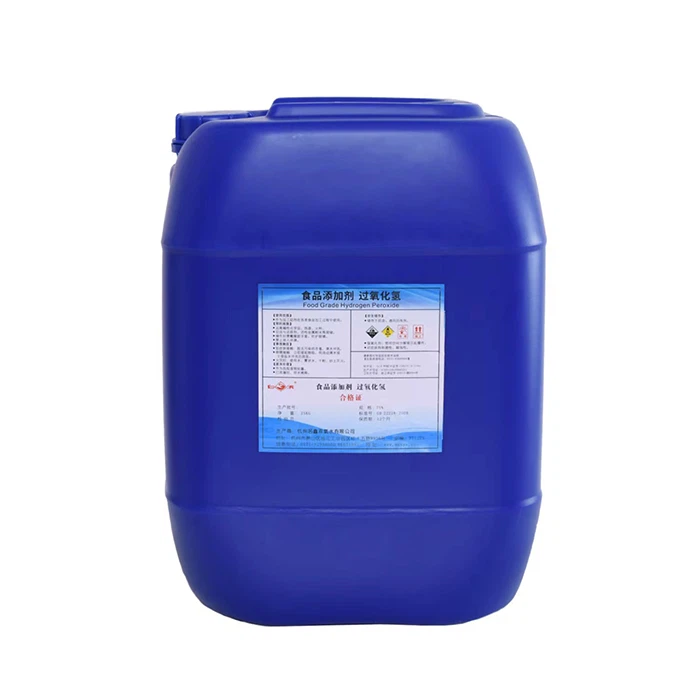
First off, let's understand what 50% Food Grade Hydrogen Peroxide is. This stuff is a powerful oxidizing agent. In the food industry, it has a bunch of uses. You can check out more details about its applications in the food processing industry here: 50% Food Additive Hydrogen Peroxide H₂O₂ for Food Processing Industry. It's commonly used for food sanitation and packaging disinfection, as described in these links: 50% Food Grade Hydrogen Peroxide H2O2 For Food Sanitation And Packaging Disinfection and 50% Food Grade Hydrogen Peroxide H2O2 for Food Sanitation and Packaging Disinfection.
Now, onto the main question: Can it be used for baby bottle disinfection? Well, hydrogen peroxide in general is known for its disinfecting properties. It works by releasing oxygen when it comes into contact with organic matter. This oxygen can break down the cell walls of bacteria, viruses, and fungi, effectively killing them. But the key here is the concentration.
A 50% concentration of hydrogen peroxide is extremely strong. In fact, it's way too strong to be used directly on baby bottles. Undiluted, it can cause chemical burns if it comes into contact with skin, and if any residue is left on the baby bottle and ingested by the baby, it can be very harmful. So, straight-up using 50% Food Grade Hydrogen Peroxide on baby bottles is a big no-no.
However, if you dilute it properly, it can be a safe and effective disinfectant. But you have to be really careful with the dilution ratio. You should aim for a much lower concentration, like 3% or even less. To achieve this, you need to mix the 50% hydrogen peroxide with a large amount of water. For example, to get a 3% solution from a 50% solution, you'd need to do some math. Let's say you want to make 100 ml of 3% hydrogen peroxide. You'd use the formula C1V1 = C2V2 (where C1 is the initial concentration, V1 is the volume of the initial solution, C2 is the final concentration, and V2 is the final volume). So, V1 = (C2V2) / C1. Plugging in the numbers, V1 = (3% * 100 ml) / 50% = 6 ml. That means you'd take 6 ml of the 50% hydrogen peroxide and add 94 ml of water to get 100 ml of 3% hydrogen peroxide.

Once you've got the right dilution, here's how you can use it to disinfect baby bottles. First, wash the bottles with hot, soapy water to remove any visible dirt or residue. Then, fill the bottles with the diluted hydrogen peroxide solution and let them soak for at least 10 - 15 minutes. After that, empty the bottles and rinse them thoroughly with clean, running water to make sure there's no hydrogen peroxide residue left.
But there are some things to keep in mind. Hydrogen peroxide breaks down over time, especially when exposed to light and heat. So, make sure to store your diluted solution in a dark, cool place and use it within a few days. Also, even though it's food grade, it's still a chemical. If you notice any signs of irritation on your baby's skin or if they seem unwell after using bottles that have been disinfected with hydrogen peroxide, stop using it and consult a doctor.
Another thing to consider is that there are other ways to disinfect baby bottles. You can use a steam sterilizer, which is a convenient and chemical-free option. Or you can boil the bottles in water for a few minutes. These methods are also effective and might be a better choice if you're not comfortable using hydrogen peroxide.
In conclusion, 50% Food Grade Hydrogen Peroxide can be used for disinfecting baby bottles, but only after proper dilution. It's a powerful disinfectant, but you have to handle it with care. If you're interested in purchasing our 50% Food Grade Hydrogen Peroxide for other food-related applications or if you have any questions about using it for baby bottle disinfection, feel free to reach out and start a procurement discussion.
References

- "Hydrogen Peroxide: Properties, Preparation, and Uses." Journal of Chemical Education.
- "Disinfection and Sterilization in the Food Industry." Food Science and Technology International.