


Hey there! I'm a supplier of 50% Food Grade Hydrogen Peroxide, and I know how crucial it is to prevent its decomposition. In this blog, I'll share some practical tips and insights on keeping this valuable chemical stable.
First off, let's understand why 50% Food Grade Hydrogen Peroxide decomposes. Hydrogen peroxide (H₂O₂) is a relatively unstable compound. It naturally breaks down into water (H₂O) and oxygen (O₂) over time. This decomposition can be accelerated by several factors, such as heat, light, metal ions, and the presence of impurities.
1. Storage Temperature
Temperature plays a huge role in the stability of 50% Food Grade Hydrogen Peroxide. High temperatures speed up the decomposition process. So, it's essential to store it in a cool place. Ideally, the storage temperature should be between 2 - 8°C (36 - 46°F). A refrigerator can be a great option for small - scale storage. But for larger quantities, you might need a specialized cold storage facility.
If you're shipping the product, make sure it's in insulated containers with ice packs or in a refrigerated truck. This way, you can maintain the low temperature during transit and prevent premature decomposition.
2. Protection from Light
Light, especially ultraviolet (UV) light, can also trigger the decomposition of hydrogen peroxide. That's why it's usually stored in dark - colored containers. Amber or brown glass bottles are commonly used for this purpose. These colors block out most of the UV light, protecting the hydrogen peroxide inside.
When storing the product, keep it away from direct sunlight or bright artificial light. If you have it on a shelf, make sure it's in a shaded area. And if you're using it in a production facility, try to use opaque pipes and tanks to transport and store the hydrogen peroxide.
3. Avoiding Contamination
Contamination is another major factor that can cause the decomposition of 50% Food Grade Hydrogen Peroxide. Metal ions, such as iron, copper, and manganese, can act as catalysts and speed up the breakdown process. So, it's important to use containers and equipment made of materials that are resistant to corrosion and don't release metal ions.
Stainless steel is a good choice for storage tanks and pipes. But make sure it's of high - quality and properly passivated to prevent any metal leaching. Also, avoid using rubber or plastic materials that might contain additives or impurities that could react with the hydrogen peroxide.
When handling the product, use clean and dry tools. Make sure your hands are clean before touching the containers or equipment. And always use dedicated equipment for hydrogen peroxide to avoid cross - contamination.
4. Use of Stabilizers
Stabilizers can be added to 50% Food Grade Hydrogen Peroxide to slow down the decomposition process. These stabilizers work by binding to metal ions or inhibiting the chemical reactions that lead to decomposition.
Some common stabilizers used in food - grade hydrogen peroxide include phosphates and stannates. These chemicals are safe for use in food applications and can significantly extend the shelf life of the product. However, it's important to use the right amount of stabilizers. Too little won't be effective, and too much can cause other issues.
5. Regular Monitoring
Regularly monitoring the quality of 50% Food Grade Hydrogen Peroxide is essential. You can test the concentration of hydrogen peroxide at regular intervals. There are simple test kits available that can give you a quick and accurate reading.
If you notice a significant drop in the concentration, it could be a sign of decomposition. In such cases, you need to investigate the cause, such as a problem with storage temperature or contamination. And take appropriate measures to correct it.
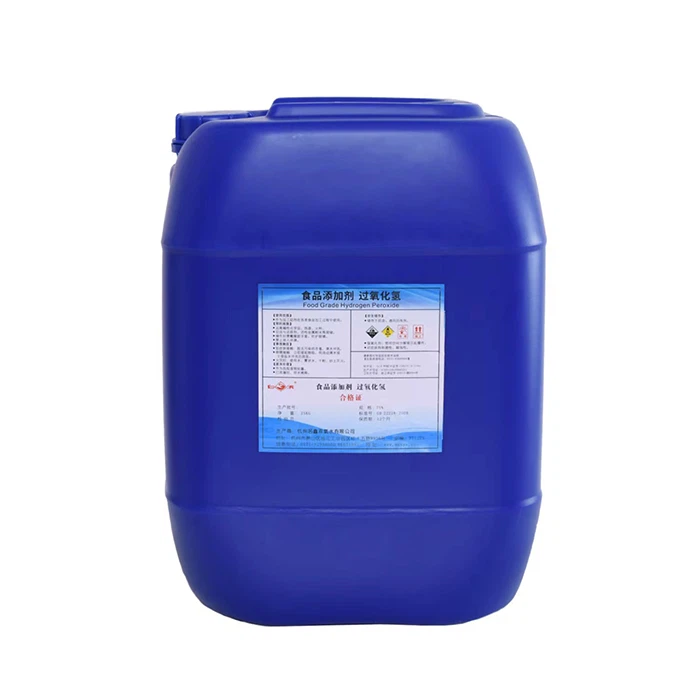

Applications of 50% Food Grade Hydrogen Peroxide
50% Food Grade Hydrogen Peroxide has a wide range of applications in the food industry. It's commonly used for 50% Food Grade Hydrogen Peroxide H2O2 For Food Sanitation And Packaging Disinfection. It can effectively kill bacteria, viruses, and fungi on food contact surfaces and packaging materials.
It's also used as a 50% Food Additive Hydrogen Peroxide H₂O₂ for Food Processing Industry. In some food processing operations, it can be used as a bleaching agent or an oxidizing agent. For example, it can be used to bleach flour or to remove impurities from food products.
Moreover, it's used for 50% Food Grade Hydrogen Peroxide H2O2 for Food Sanitation and Packaging Disinfection. It helps in maintaining the hygiene and safety of food products during production and storage.
Conclusion
Preventing the decomposition of 50% Food Grade Hydrogen Peroxide is crucial for its effective use in the food industry. By controlling the storage temperature, protecting it from light, avoiding contamination, using stabilizers, and regularly monitoring its quality, you can ensure that the product remains stable and effective.
If you're in the food industry and looking for high - quality 50% Food Grade Hydrogen Peroxide, I'm here to help. Whether you need it for food sanitation, packaging disinfection, or food processing, I can provide you with a reliable supply. Contact me to discuss your requirements and start a procurement conversation.
References
- Kirk - Othmer Encyclopedia of Chemical Technology.
- Handbook of Food Additives.
- Journal of Food Science and Technology.