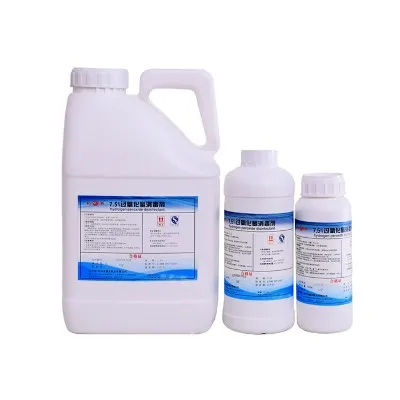


The use of hydrogen peroxide is divided into three categories: medical and industrial. The daily disinfection is medical hydrogen peroxide. Medical hydrogen peroxide can kill intestinal pathogens, pyogenic cocci, and pathogenic yeasts. It is generally used for surface disinfection. Hydrogen peroxide has an oxidizing effect. Hydrogen peroxide bleaching mechanism. Hydrogen peroxide bleaching mechanism, but the concentration of medical hydrogen peroxide is equal to or lower than 3%. If it is wiped on the wound surface, there will be a burning sensation, the surface will be oxidized to white and air bubbles. Clean it with water That's it, the original skin tone will be restored in 3-5 minutes. In the chemical industry, it is used as raw materials for the production of sodium perborate, sodium percarbonate, peracetic acid, sodium chlorite, thiourea peroxide, etc., as well as oxidizing agents for tartaric acid and vitamins. In the pharmaceutical industry, it is used as a fungicide, disinfectant, and an oxidant for the production of thiram insecticide and 40l antibacterial agent. In the printing and dyeing industry, it is used as a bleaching agent for cotton fabrics, to reduce the color of the hair after dyeing. Used to remove iron and other heavy metals in the production of metal salts or other compounds. It is also used in electroplating solution to remove inorganic impurities and improve the quality of plating parts. It is also used for bleaching wool, raw silk, ivory, pulp, fat, etc. The high concentration of hydrogen peroxide can be used as a rocket power combustion aid. Civil use: To deal with the peculiar smell of the kitchen drain, buy hydrogen peroxide, add water and washing powder at the pharmacy, and pour it into the drain for decontamination, disinfection and sterilization; 3% hydrogen peroxide (medical grade) can be used for wound disinfection;
Chemical reaction / hydrogen peroxide
Hydrogen peroxide is a very strong oxidant. The standard electrode potential values of hydrogen peroxide and other oxidants are listed on the right. The higher the value, the stronger the oxidation.
Decomposition reaction
Hydrogen peroxide can spontaneously decompose and disproportionate to produce water and oxygen: ΔHo is -98.2 kJ·mol-1, ΔGo is -119.2 kJ·mol-1, and ΔS is 70.5 J·mol-1·K-1. Heavy metal ions Fe2+, Mn2+, Cu2+, etc. have a catalytic effect on the decomposition of hydrogen peroxide. Hydrogen peroxide is relatively stable in acidic and neutral media, and easily decomposes in alkaline media. Irradiation with light with a wavelength of 320~380nm will speed up the decomposition of hydrogen peroxide, so hydrogen peroxide should be stored in a brown bottle and placed in a cool place.
The mixed solution of H2O2 and Fe2+ is called Fenton's reagent (Fenton). Catalyzed by certain ions such as Fe2+ and Ti3+, the decomposition reaction of hydrogen peroxide will generate free radical intermediates HO· (hydroxyl radicals) and HOO·.Generally used hydrogen peroxide contains a certain amount of stabilizer to reduce the decomposition of hydrogen peroxide. Commonly used stabilizers include: sodium stannate, sodium pyrophosphate and organic phosphite.
Redox reactions
Hydrogen peroxide can oxidize or reduce many inorganic ions in aqueous solutions. When used as a reducing agent, the product is oxygen, when used as an oxidant, the product is water. For example, in acidic solution, hydrogen peroxide can oxidize Fe2+ to Fe3+: with hydrogen peroxide, sulfite (SO32-) can be oxidized to sulfate (SO42-), and potassium permanganate can be reduced in acidic solution It is Mn2+. Due to the standard electrode potential, the reaction may proceed in different directions under different pH environments. For example, in an alkaline solution, hydrogen peroxide will oxidize Mn2+ to MnIV, which is generated as MnO2.
The reaction of hydrogen peroxide to reduce sodium hypochlorite can be used to prepare oxygen in the laboratory; In organic chemistry, hydrogen peroxide is often used as an oxidizing agent to oxidize sulfide to sulfoxide. When methyl phenyl sulfide reacts with it, it will be oxidized to methyl phenyl sulfoxide, using methanol as solvent or titanium trichloride as catalyst, and the yield is 99%;The alkaline solution of hydrogen peroxide can be used for the epoxidation of electron-rich olefins (such as acrylic acid) and the oxidation of alkyl boron to alcohol in the second step of the hydroboration-oxidation reaction. When hydrogen peroxide reacts with many inorganic or organic compounds, the peroxy chain is retained and transferred to another molecule to form a new peroxide;When hydrogen peroxide reacts with chromic acid or dichromate acid solution at low temperature, it will produce unstable blue chromium peroxide CrO(O2)2, which can be extracted with ether or amyl alcohol. Chromium peroxide in the aqueous solution quickly decomposes into oxygen and chromium ions.
Hydrogen peroxide reacts with borax to generate sodium perborate, which can be used as a disinfectant;Hydrogen peroxide can generate many inorganic salts containing O22-peroxide ions, of which the more important ones are calcium peroxide, sodium peroxide and magnesium peroxide.
It reacts with carboxylic acid (RC=O-OH) to generate oxidizing peroxy acid (RC=O-O-OH), which can be used for olefin epoxidation and other purposes. It reacts with acetone to generate triacetone peroxide (TATP), reacts with ozone to generate dihydrogen trioxide, and reacts with urea to generate urea peroxide.
Hydrogen peroxide and triphenylphosphine oxide form acid-base adducts, which are used as equivalent reagents for hydrogen peroxide in some reactions.
Alkaline
Compared with water, hydrogen peroxide is much weaker and only reacts with strong acids to form adducts. The super acid HF/SbF5 can protonate hydrogen peroxide to produce a product containing [H3O2]+ ions.