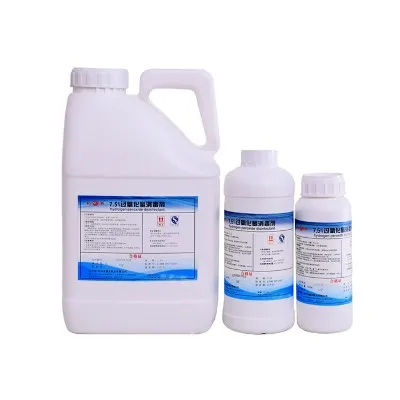


What are the hydrogen peroxide stabilizers?
Hydrogen peroxide is a very good oxidizing bleaching agent. When using hydrogen peroxide bleaching, a certain amount of stabilizer is generally added to reduce the decomposition of hydrogen peroxide.
The stabilizers of hydrogen peroxide can generally be divided into adsorption stabilizers and complex stabilizers. Most of the hydrogen peroxide adsorption stabilizers are inorganic compounds or polymer organic substances. These substances are in colloidal state under certain conditions, and have a good effect on metal ions. Relatively strong adsorption, which can inhibit the catalytic decomposition of heavy metal ions on hydrogen peroxide, and play a stabilizing effect. The complex stabilizers of hydrogen peroxide are mostly organic acid multivalent complexing agents, which can complex with metal ions. Cooperate to form a stable water-soluble complex, so that heavy metal ions do not have a catalytic effect.
Common hydrogen peroxide adsorption type stabilizers include silicate, adsorption type off-molecule compounds (such as acrylic acid, maleic acid, oxamide and other polymers.)
Common complex stabilizers include sodium aminotriacetate, sodium ethylenediaminetetraacetate, sodium diethylenetriaminepentaacetate, etc., as well as trimethylene phosphonate, ethylenediaminetetramethylene phosphonate , Diethylene triamine pentamethylene phosphonate. Gluconic acid, malic acid and so on.
There is also a hydrogen peroxide mixed stabilizer, which is also a hydrogen peroxide oxygen stabilizer that has both adsorption capacity and complexation. This kind of hydrogen peroxide stabilizer combines the advantages of adsorption type hydrogen peroxide stabilizer and complex type hydrogen peroxide stabilizer.
In addition to water glass, the more commonly used hydrogen peroxide bleaching bath stabilizers include phosphates such as disodium hydrogen phosphate, trisodium phosphate, hot sodium phosphate and sodium hexametaphosphate as stabilizers for hydrogen peroxide bleaching. The characteristics of the stabilizers in these commonly used hydrogen peroxide bleach baths are that they can overcome the shortcomings of easy scaling when the water glass is used as a stabilizer. However, the cost of these stabilizers is relatively high, the whiteness of the fabric, the permeability and the ability to remove cotton seed hulls, etc. Not as good as water glass.
What are the requirements for water quality for hydrogen peroxide bleaching
In the process of bleaching with hydrogen peroxide, there are some requirements for water quality. The quality of the water directly affects the effect of hydrogen peroxide bleaching. The use of hard water for hydrogen peroxide bleaching is generally harmful. However, during hydrogen peroxide bleaching, the calcium and magnesium salts in hard water can prevent the decomposition of hydrogen peroxide, so hard water can be used when preparing hydrogen peroxide bleach.